Private practice urology is being asked to do more with less. For CY2026, urology faces a 0% net impact on total Medicare allowed charges, a proposed 2% decrease for CY2027, and CMS-projected practice cost growth of 2.7%.1,2,3 The share of urologists in private practice fell from 62.8% in 2014 to 43.2% in 2025.4
Against that backdrop, it’s reasonable for a practice to look for relief wherever it can find it. An ambient scribe for the note. An AI phone agent for the front desk. A coding tool for the claim. A trial-matching app for research. A prior authorization tool for the payer.
A fragmented, app-by-app approach is one some practices may choose to try, and for a single bottleneck it can help. Tools designed to solve a single problem often solve that problem quite well. But the clinical workflow isn’t a set of separate jobs. It is one patient moving through intake, the visit, the plan, the procedure, follow-up, and billing, often on several pathways at once. The work that exhausts a clinic lives in the handoffs between those steps. The messy reality of those handoffs is exactly what point solutions can't fix.
01Every condition has a pathway of care. Every patient has several pathways.
Clinical pathways are how a practice encodes its standard of care: when to repeat a PSA, when a BPH patient moves from medication to a procedure, what imaging follows a ureteroscopy, who qualifies for a trial. Most practices already have them. They live in a flowchart, a guideline PDF, a protocol binder, a poster on the wall, a payer’s policy page.
In clinic, every doctor has hundreds of patients, every patient may sit on several pathways at once, and the facts that decide eligibility are scattered across years of notes, outside labs, imaging, and prior treatment. The first step toward better care is defining the pathways, but the problem with defining a pathway and writing down (and then laminating it and posting it on a wall) is the accompanying assumption that the problem of managing scattered pathways has been solved.
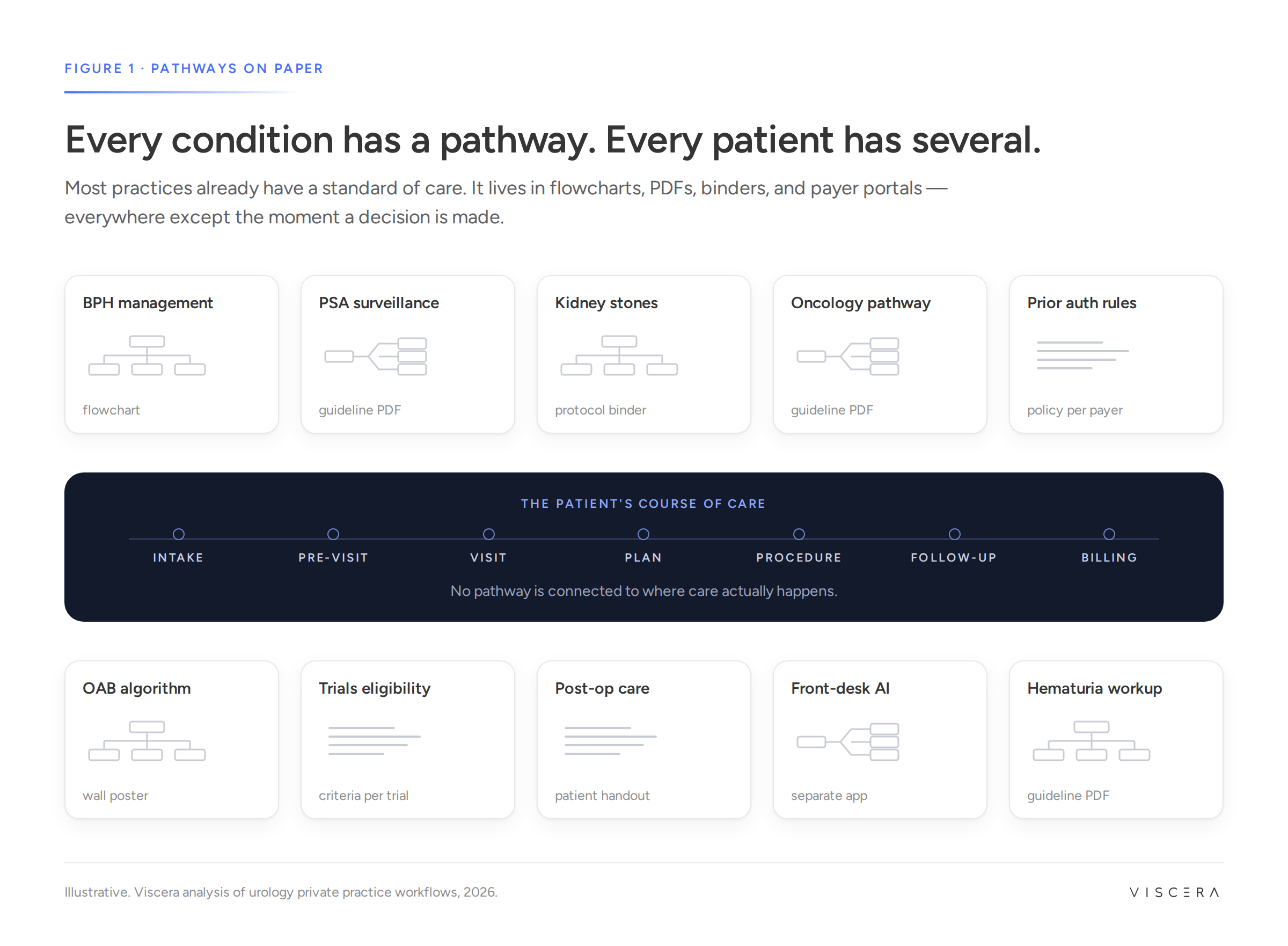
Publishing a pathway doesn’t change what happens in the exam room. The committee approves it. Someone updates a document, sends an email, and schedules a training. Then, during a busy clinic, the provider still has to remember that something changed, find the guidance, and apply it to the patient in front of them.
A pathway that can’t act on the patient’s course of care is just a laminated poster.
The gap is measurable. A Michigan Urological Surgery Improvement Collaborative (MUSIC) study of 2,850 ureteroscopy patients across 11 practices found that 47.6% received postoperative imaging within 60 days — with practice rates ranging from 23.7% to 73.6%, despite existing guidelines and an imaging algorithm.5 That doesn’t mean patients without imaging received inappropriate care, but it does demonstrate that publishing guidance does not ensure consistent execution of the guidance.
02The cost of pathways that never activate
Practices have learned to accept the gap as the cost of doing business.
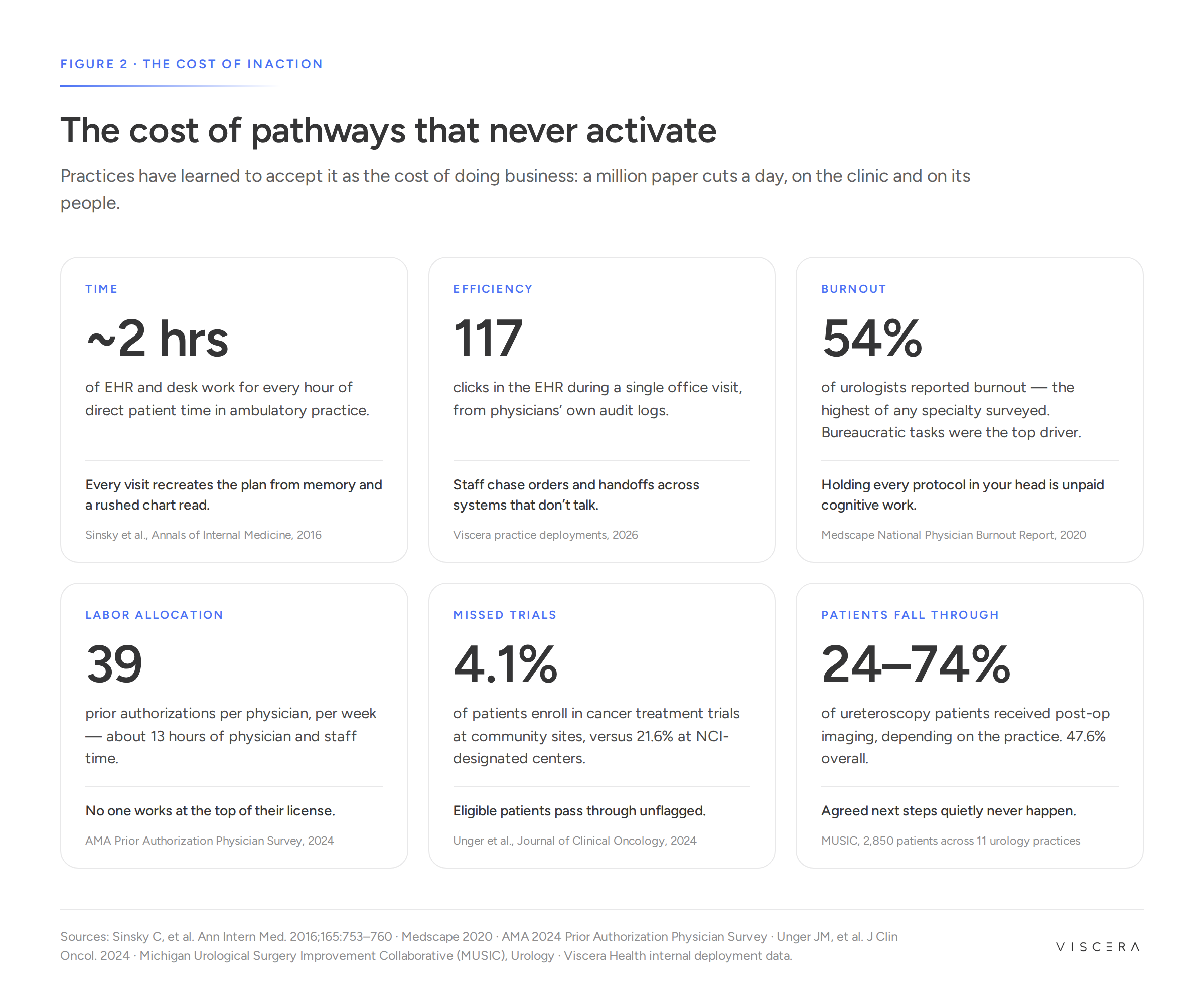
Ambulatory physicians spend nearly two hours on EHR and desk work for every hour of direct patient time.6 Urology topped Medscape’s 2020 national burnout ranking at 54%, with bureaucratic tasks the most cited driver.7 Practices complete roughly 39 prior authorizations per physician per week, about 13 hours of physician and staff time.8 In oncology, community sites enroll 4.1% of patients in cancer treatment trials, versus 21.6% at NCI-designated centers.9
None of those numbers is a technology problem on its own. Each one is what happens when the standard of care depends on someone remembering it, finding the facts, and carrying the next step forward by hand.
03Point solutions work one thread at a time
This is where the app-by-app approach looks attractive. Pick the most painful thread — scheduling reminders, prior authorization, denial defense — and buy a tool for it. The tool learns that one thread, and on that line it works.
But it misses the macro picture. Map a typical set of single-purpose tools against a practice’s pathways and course of care, and the pattern is hard to miss: short, bright segments of coverage, surrounded by work that still falls to physicians and staff.
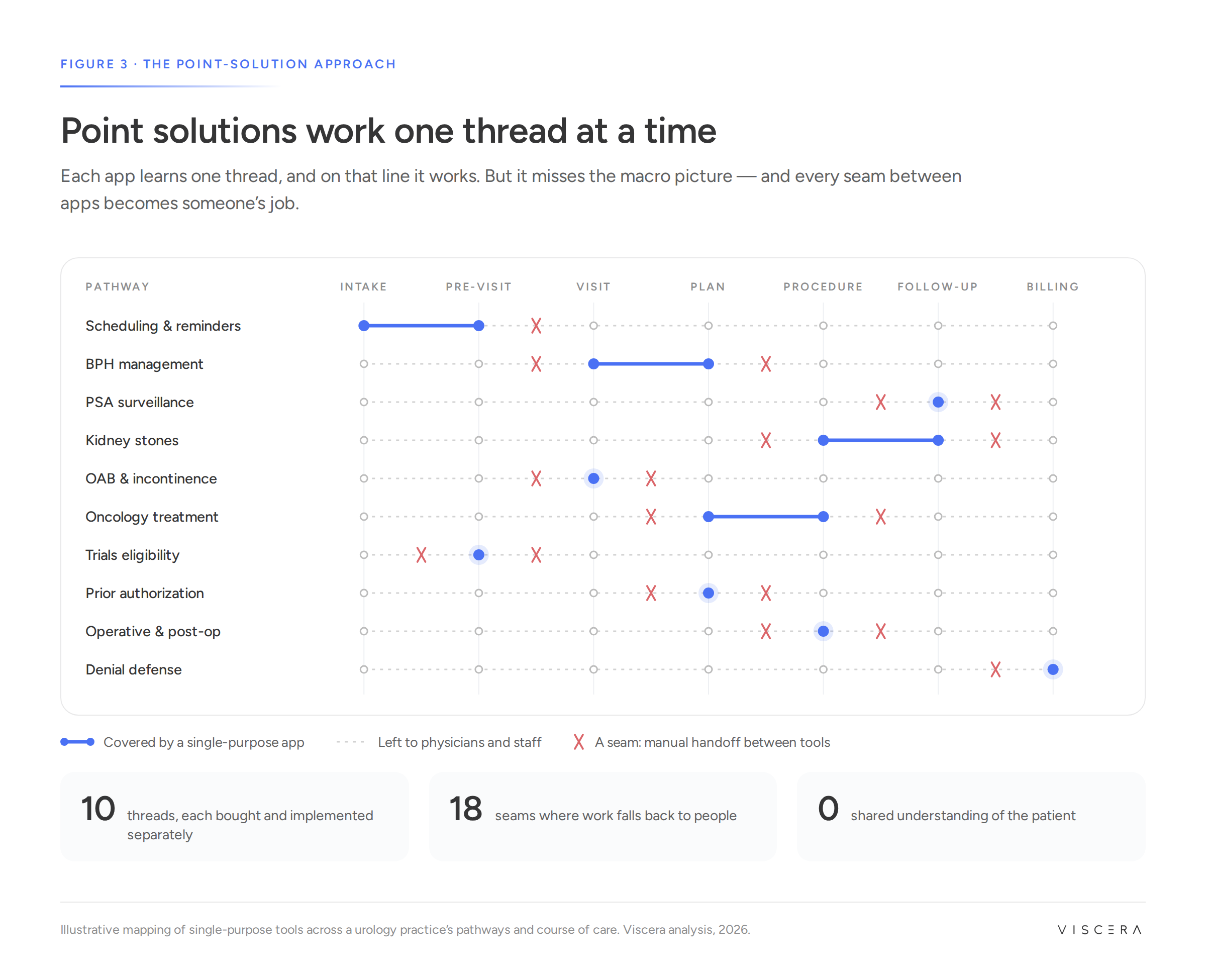
Three problems follow from that picture.
Each app reconstructs its own version of the patient.
The scribe knows what was said in the room. The coding tool knows what made it into the note. The trial app knows what it can query. The phone agent knows the schedule. None of them knows the whole patient — the prior treatment, the response, the finding buried in an outside report from three years ago. Pathway eligibility rarely lives in a single diagnosis code, so a tool that only sees its own slice can’t reliably say where a patient stands.
Every seam becomes someone’s job to manage.
Wherever one tool’s output has to become another tool’s input, a person does the translation. Usually that person is the physician or a member of the care team. Across the practices Viscera has taken live, physicians’ own audit logs counted 117 clicks in the EHR during a single office visit. In one practice, integration surfaced 27 variants of the same billing code, accumulated through years of staff changes and office workarounds.10 Adding more tools adds more seams.
Ambient AI scribes are the clearest example. The largest controlled study to date, across 8,581 clinicians at five academic health systems, measured about 16 minutes of documentation time saved per clinic day and no change in after-hours EHR time.11 The scribe automated the typing. The translation into diagnoses, orders, levels, and EHR fields stayed manual.
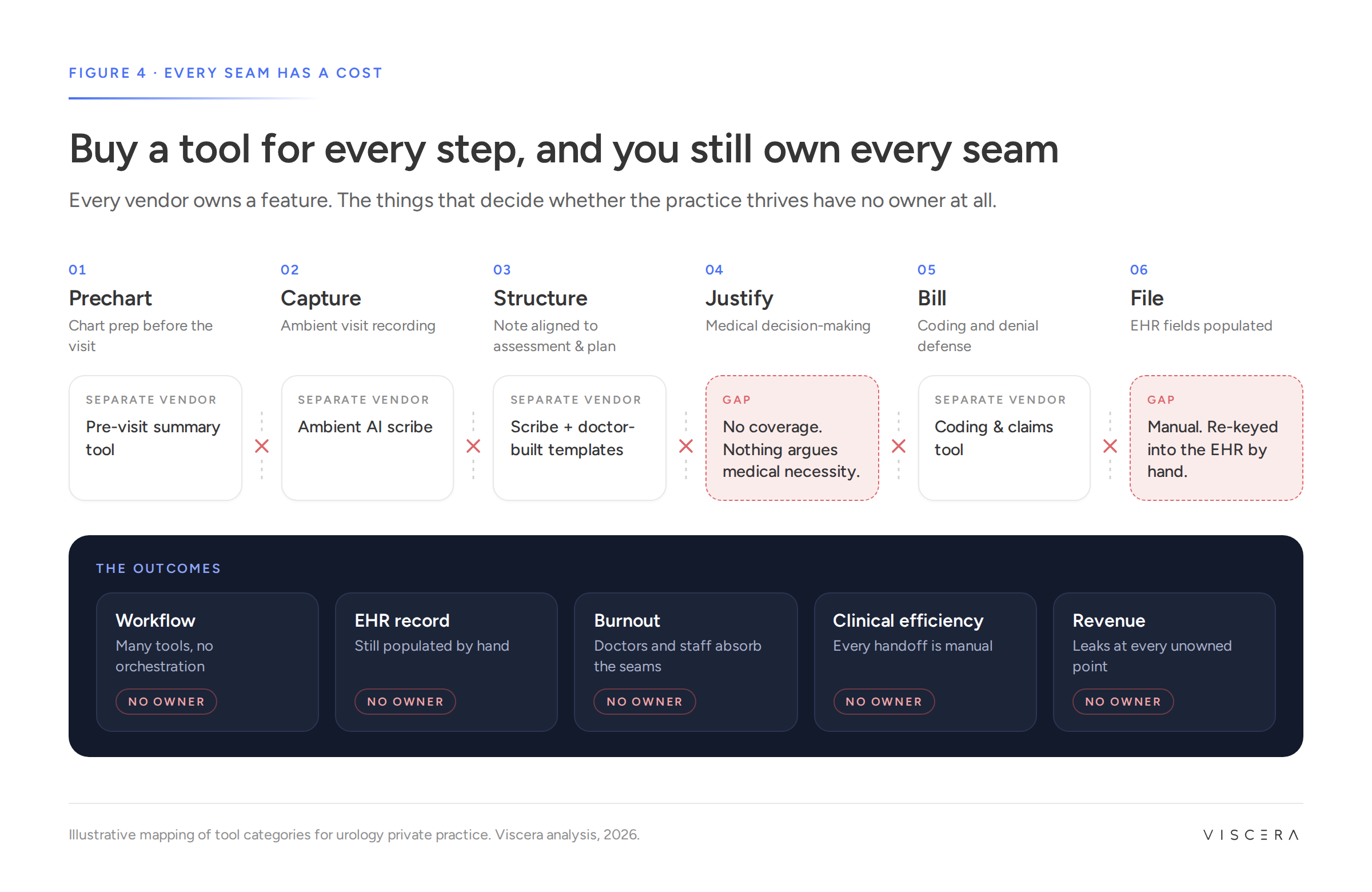
No one owns the outcome.
A practice can buy a tool for every step and still own every seam. Each vendor is accountable for its feature. The things that decide whether the practice thrives — whether the workflow runs end to end, whether the EHR record is complete, whether burnout falls, whether revenue holds up under review — have no owner at all. Some steps have no coverage: nothing in a typical stack argues medical necessity, and the EHR is still populated by hand.
04A pathway is an output, not a foundation
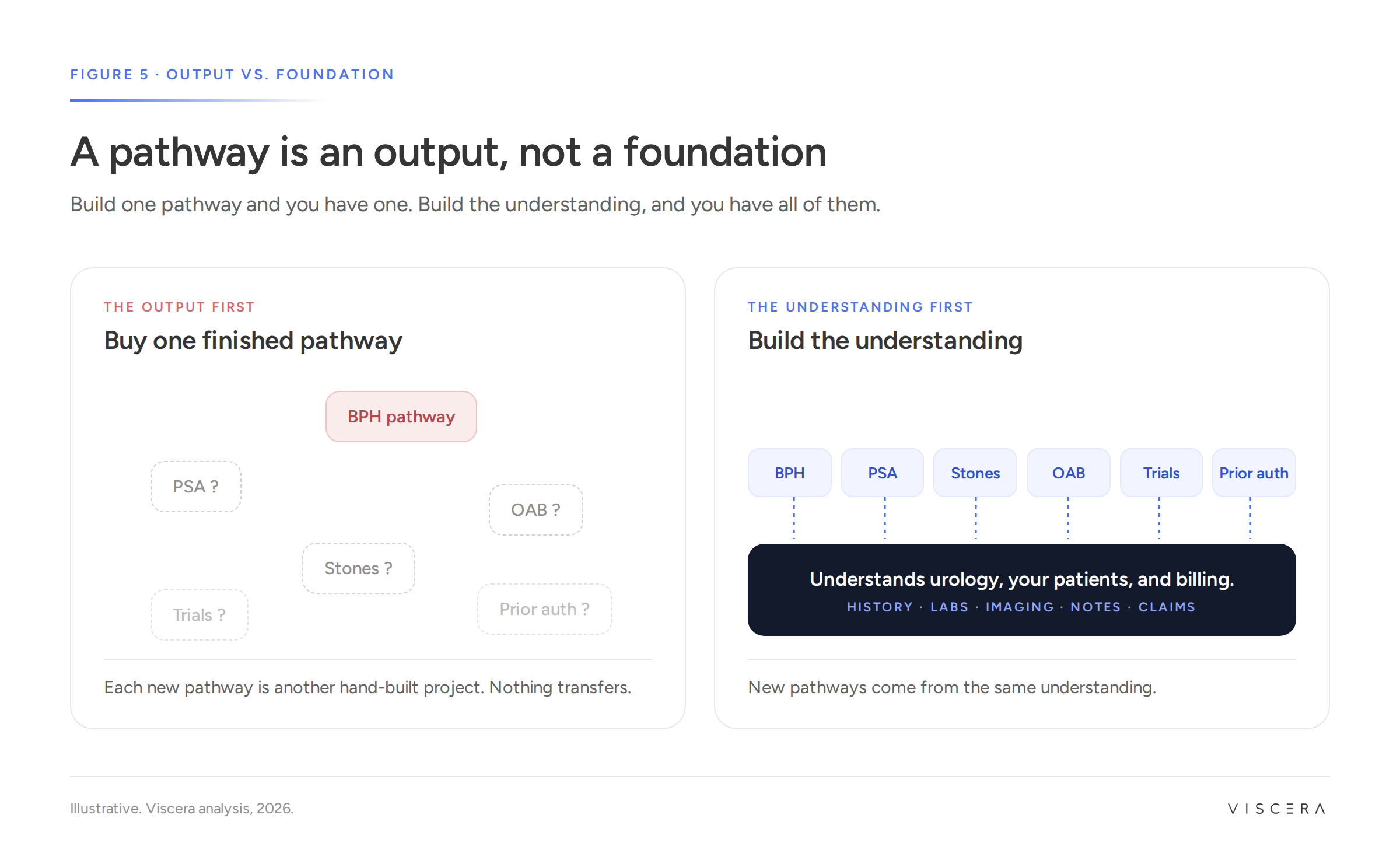
There’s a deeper reason the app-by-app approach stalls. A pathway is the result of understanding a patient against a standard. Buy one finished pathway and you have one. The next pathway is another hand-built project, because nothing the first tool learned about your patients transfers.
Build the understanding instead — of urology, of your patients, and of billing — and new pathways come from the same place.
The evidence on clinical pathways points the same way. Where operationalized standards have worked, the programs involved more than distributing a pathway.
A statewide MUSIC intervention across 42 urology practices cut non-indicated bone scans in localized prostate cancer from 11.0% to 6.5% and non-indicated CT scans from 14.7% to 7.7%, while recommended imaging held steady and variation between practices narrowed.12 In community oncology, pathway-concordant lung cancer care was associated with 35% lower outpatient costs over 12 months, with no observed difference in overall survival.13 A community practice in the Oncology Care Model held drug-spending growth to 18.6% against a 34.4% benchmark after adopting pathways.14
What those programs share is instructive. Recommendations were built into the EHR. Exceptions were reviewed prospectively. Adherence was measured in real time and reviewed on a regular cadence by a governance group. Guidance, workflow, measurement, and governance worked together. That is a system problem, not an app problem.
05The new standard for a pathway that works
If a pathway is going to change care rather than describe it, it has to pass three tests.
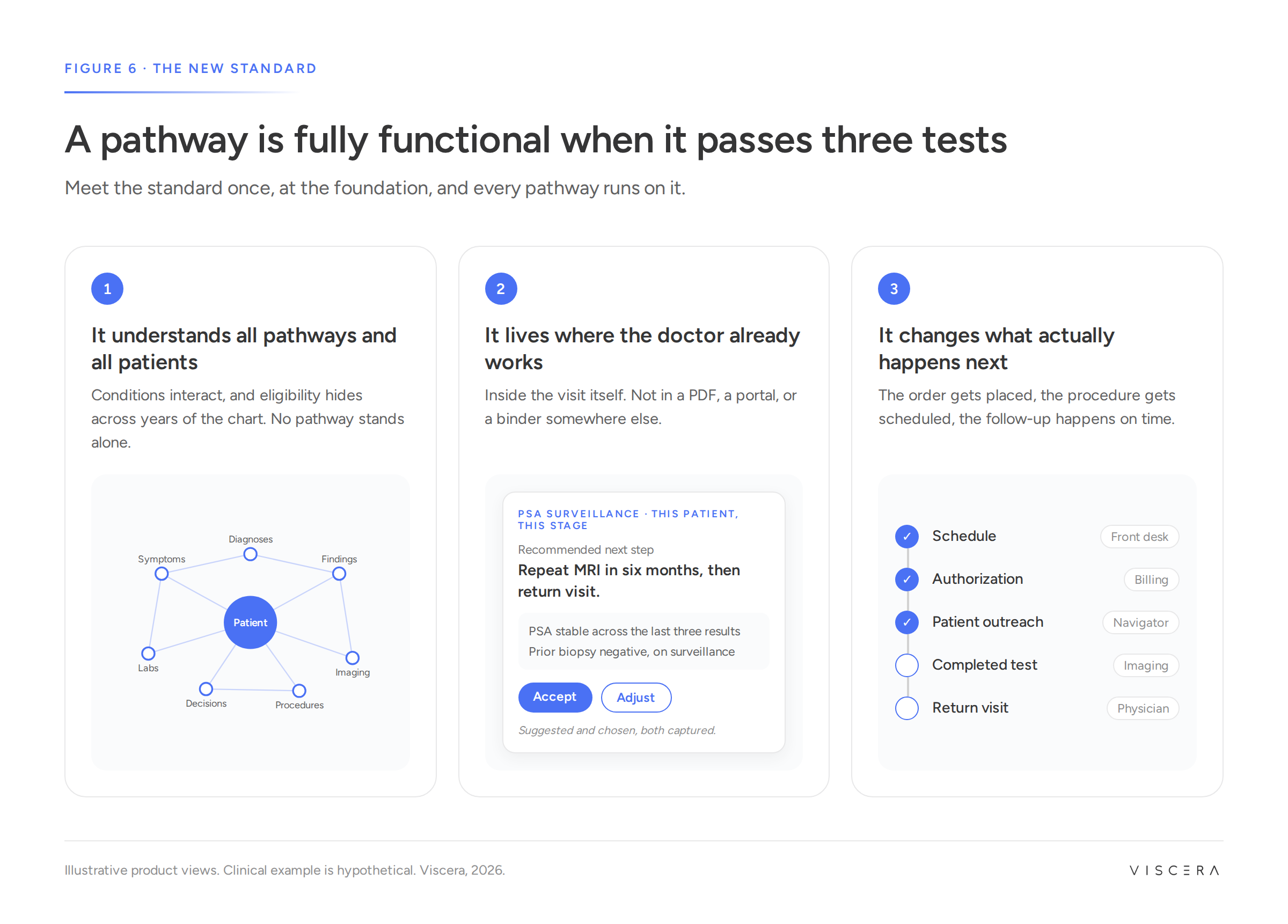
1. It understands all pathways and all patients.
Conditions interact, and eligibility hides across years of the chart. No pathway stands alone. The foundation has to turn fragmented documentation into usable clinical evidence, and reconcile it as new information arrives: distinguish new evidence from corroborating findings, weigh the authority of each source, and flag conflicts and uncertainty.
That takes an ontology — a data map of the physical reality of care. Patients, symptoms, findings, diagnoses, decisions, treatments, procedures: every entity in urologic care, and how each relates to the rest. Build the map once, and population identification, eligibility, staging, the next clinical decision, and the bill all read from the same understanding. Otherwise, each workflow reconstructs its own version of the patient.
The EHR can’t do this on its own. The EHR was built as a system of record, essentially a digital filing cabinet, not a system of process. Its job is to hold discrete, auditable facts, not to move a patient through a longitudinal course of care.
2. It lives where the doctor already works.
Asking clinicians to navigate another decision tree adds work at the moment they have the least time. A complete flowchart can be useful as a reference and still be cumbersome during an encounter. What the clinician needs is the next decision for this patient: this patient, at this stage, with these supporting facts, and these next options.
The clinician stays in command. They can inspect the reasoning, accept the recommendation or change it, and make the call. The system records what was suggested and what was chosen, together. That consistent decision capture is what connects a practice’s clinical intent to the care that actually happens.
3. It changes what actually happens next.
The visit is one moment in a longer course of care. An agreed next step may require scheduling, authorization, patient outreach, a completed test, or a return visit months later. An order in the chart doesn’t mean the care happened.
That work needs a persistent care plan: what was decided, what remains outstanding, who owns it, and when it’s due. Staff and connected services run the plan against the same patient record, and every result and response returns to it. Leadership can finally tell the difference between a clinical decision to depart from the pathway and an agreed action that never happened — and know where to intervene.
Meet the standard once, at the foundation, and every pathway runs on it.
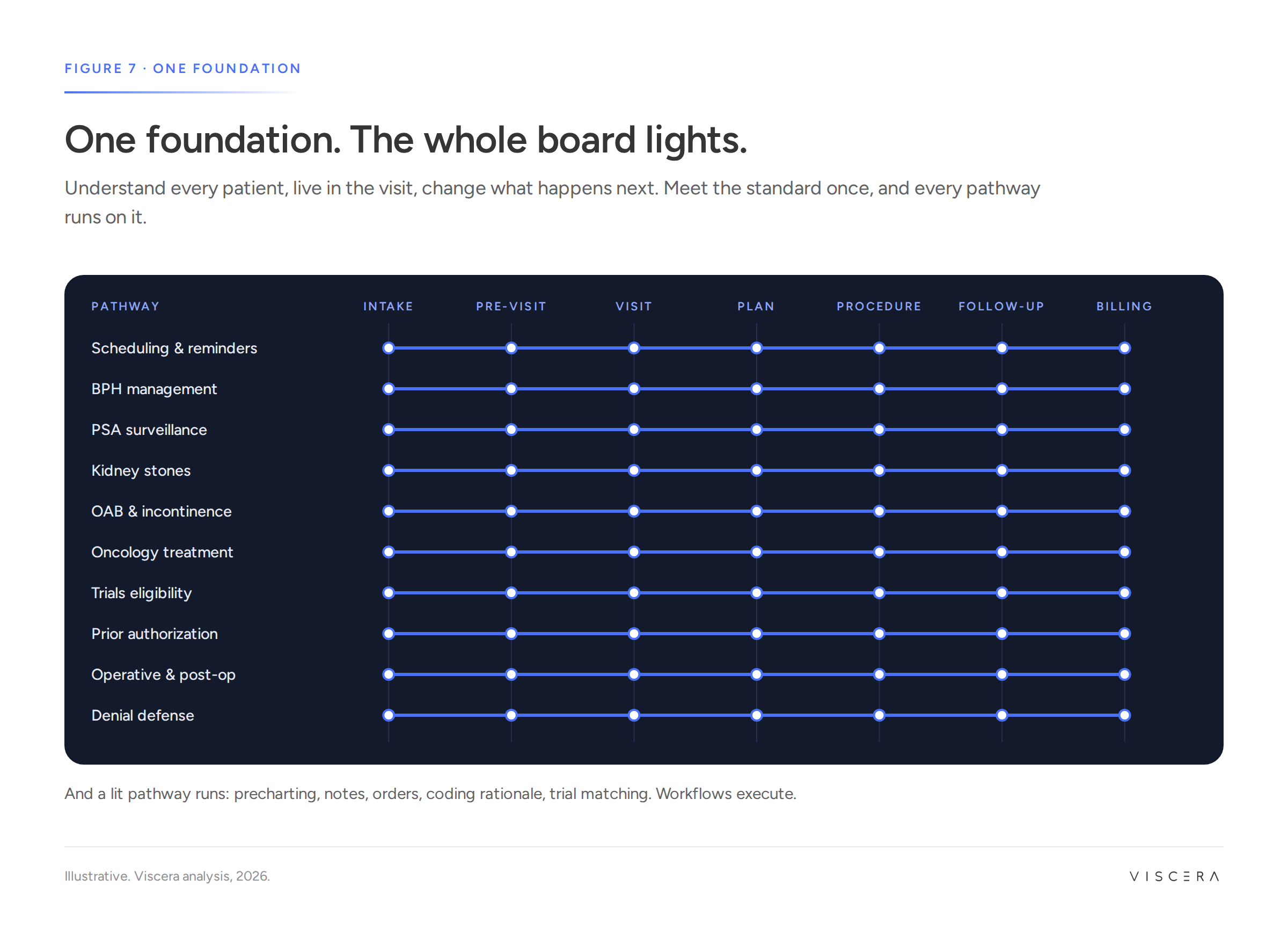
A lit pathway runs: precharting, notes, orders, coding rationale, trial matching. The workflow executes instead of waiting on someone to push it along. It also creates a practical improvement loop — see where care diverges, understand why, refine the program, and bring the change back into everyday practice without another rollout.
06First the foundation, then the plug-ins
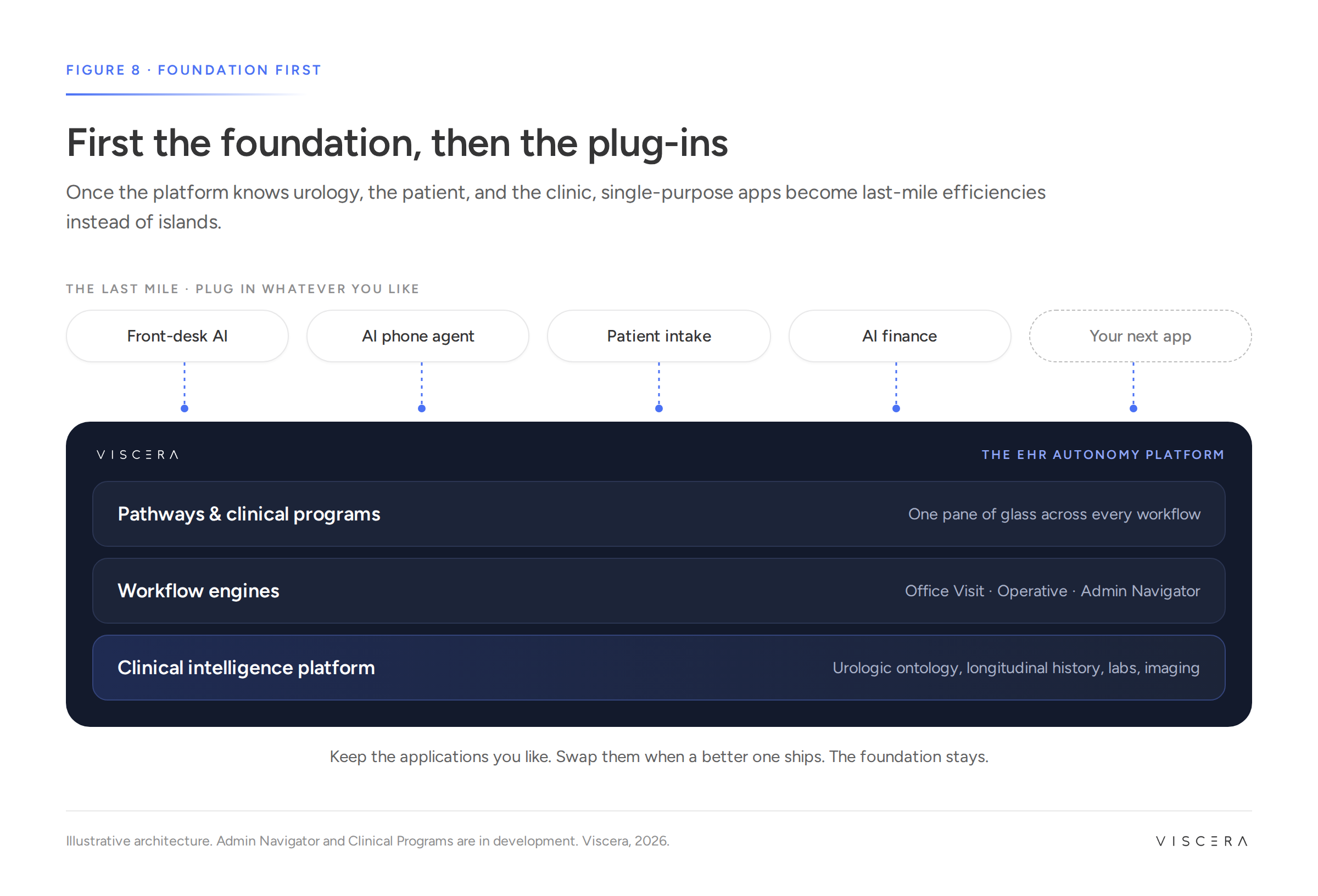
None of this is an argument against apps. A good AI phone agent or intake tool can take real work off a front desk. The question is what it plugs into.
Once the platform knows urology, the patient, and the clinic, single-purpose tools stop being islands and become last-mile efficiencies. They read from the same patient understanding and write back to the same care plan. Keep the applications you like. Swap them when a better one ships. The foundation stays.
07Six questions to ask before adding another point solution
For practices weighing one more tool, these questions help separate a real workflow improvement from one more seam.
- 01Which step does this tool own, and who handles the handoff on either side?If the answer is “your staff,” count those handoffs as part of the cost.
- 02Does it read from the same understanding of the patient as our other tools?Or does it build its own partial copy from whatever it can see?
- 03Where does its output land?In discrete EHR fields, or in a document someone has to read and re-key?
- 04When we add the next pathway, what transfers from this one?If nothing does, every new pathway is a new project.
- 05Can we see where an agreed next step stalled, and why?Clinical exception, patient choice, insurance barrier, or a task that never happened.
- 06Who owns the outcome?Not the feature. The workflow, the record, the revenue, and the time it gives back.
08How Viscera approaches it
Viscera is the EHR autonomy platform for urology private practice: one clinical foundation that understands urology, the patient, and the clinic, with workflow products built on top of it. It pre-charts every patient before the doctor walks in, builds a structured note, places diagnoses and orders, generates billing and denial defense documentation, and updates the EHR and the patient’s pathway before the doctor leaves the room. Providers review and sign; they don’t copy and paste.
Works with the EHR you already run. Viscera runs alongside the systems practices use today, with integrations across NextGen, athenahealth, ModMed, and Veradigm. A practice doesn’t need to replace its EHR or wait for a migration to start: the foundation begins with the systems in place today, and deeper integration removes manual handoffs over time.